
What happens when a flat roof faces persistent rain, gusting wind, and damp conditions that linger? For commercial property owners in the Northwest, it’s reasonable to wonder whether water will find a weak point. The impact of pacific northwest weather on flat roofs depends not only on the weather itself, but also on how the roof directs water and protects its seams, edges, and transitions.
This article explains how rain, wind, and ongoing moisture affect flat-roof systems, and why drainage, flashing, and installation details matter. You’ll also learn how TPO, PVC, and EPDM membranes fit into planning a commercial roof installation or replacement. Whether your building is in Vancouver, Battle Ground, Camas, Ridgefield, La Center, Longview, Kelso, Woodland, Castle Rock, or Kalama, understanding local weather stresses can help you plan your next project with confidence.
Key Takeaways
- “Flat” roofs still need drainage. Roof shape, slope, and water flow all matter during installation planning.
- The impact of pacific northwest weather on flat roofs makes careful planning for seams, penetrations, edges, and flashing important.
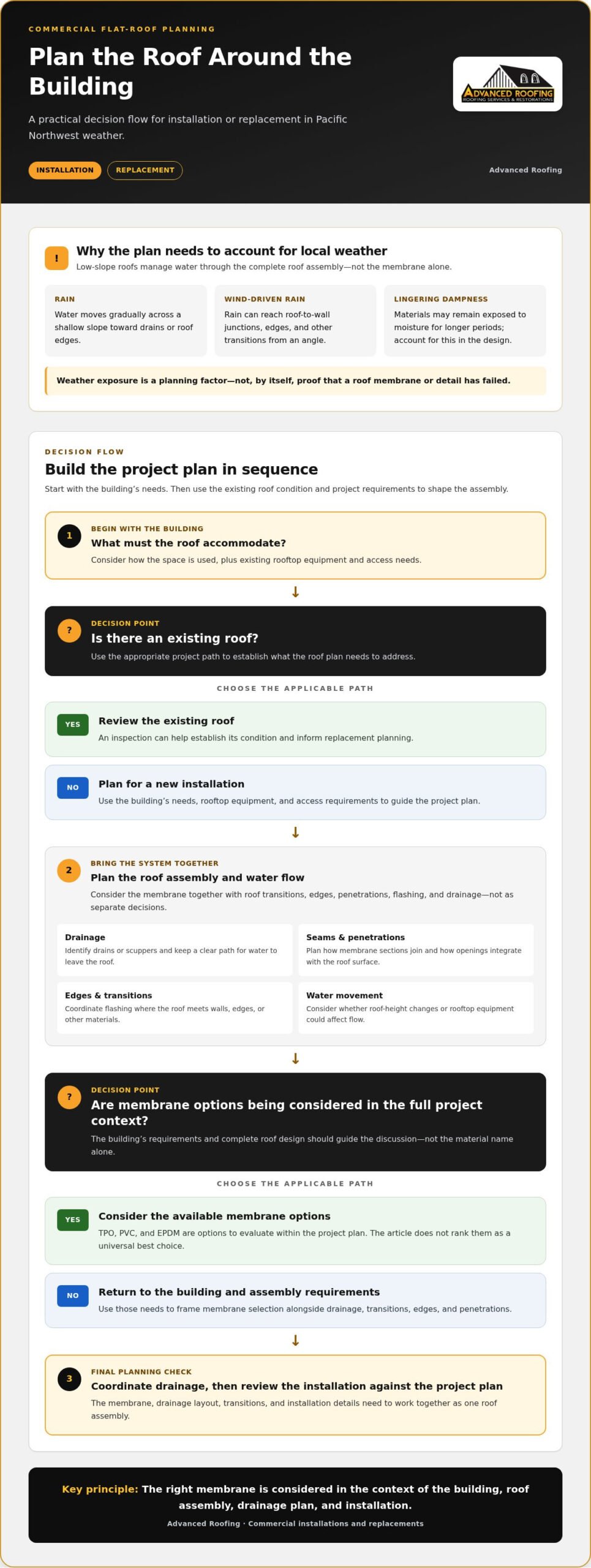
- Plan a commercial roof project in sequence, starting with building needs and considering the roof assembly and drainage details before reviewing the installation.
- Compare TPO, PVC, and EPDM as membrane options for a commercial roof installation or replacement, with the right choice guided by the building and project requirements.
How Pacific Northwest Rain and Dampness Affect Flat Roofs
A flat roof isn’t necessarily level. The term commonly describes a roof with a shallow slope, rather than the steep angle seen on many residential roofs. That slope directs water toward drains or roof edges. For commercial buildings in Vancouver and across the region, the impact of pacific northwest weather on flat roofs depends in part on how the roof assembly manages repeated exposure to rain and lingering moisture.
Rain alone doesn’t prove that a roof has a defect, but it means the roof surface and drainage pathways face regular exposure. A helpful overview of flat roof design and common problems explains why drainage and water movement are central considerations for these systems.
What rain, wind, and seasonal dampness mean for a low-slope roof
On a low-slope surface, water moves toward drainage points more gradually than it does on a steep roof. The design needs a clear path for water to leave the roof. During project planning, identify where drains or scuppers are located and consider whether changes in roof height or rooftop equipment could affect water flow. Debris can obstruct drainage paths, so keeping those areas clear is a practical part of building maintenance.
Wind-driven rain can reach transitions and details from an angle. Where the roof meets a wall, an edge, or another material, those junctions need to be integrated into the roof assembly so water can drain as intended. Persistent dampness also means roof materials remain exposed to moisture for longer periods. That is a condition to account for in the design, not proof that a membrane or detail has failed.
During a commercial roof installation or replacement, consider the assembly as a whole: the membrane, drainage layout, transitions, and installation details all need to work together. An inspection can help establish the condition of an existing roof and inform replacement planning.
Quotable takeaway: Northwest weather tests a flat roof’s water-management design, while the quality of its assembly details helps determine how well the system handles that exposure. Understanding both factors gives property owners a practical foundation for planning a commercial roof project.
Which Flat-Roof Details Matter Most in Portland and Vancouver?
On a commercial flat roof, water protection depends on more than the visible membrane. Drainage should guide water toward designated outlets and off the roof instead of allowing it to collect. For buildings in Vancouver and nearby Southwest Washington communities, planning these details as one assembly helps address local weather exposure. The membrane matters, but it is only one part of the system.
How drainage, flashing, and membranes work together
Each component has a role. The membrane forms the roof’s water-shedding surface, and its seams join sections into a continuous layer. Roof penetrations, such as openings for equipment or other features, need details that integrate with the membrane. At roof edges and wall transitions, flashing helps manage the junction between surfaces. Drainage then directs water toward outlets and away from vulnerable details.
These elements are connected. An outlet’s position affects the drainage plan, while penetrations and transitions need to fit within the membrane layout. Edge details complete the assembly around the roof perimeter. When planning an installation or replacement, review these elements together rather than treating drainage, flashing, and membrane selection as separate decisions. A membrane still depends on careful detailing and installation.
Quotable takeaway: A membrane’s name alone can’t explain roof performance; drainage, seams, penetrations, flashing, and installation all contribute to how the complete assembly handles weather. That’s a useful way to think about the impact of pacific northwest weather on flat roofs when planning a project in the region.
Advanced Roofing installs and replaces commercial flat-roof systems in Vancouver and surrounding Southwest Washington areas. Property owners planning a project can explore commercial roof installation and replacement as a practical next step toward a coordinated roof assembly.
Planning a Flat-Roof Installation or Replacement for PNW Weather
A well-planned commercial roofing project starts with the building, not a product label. The impact of pacific northwest weather on flat roofs is one reason to consider how the roof will function as a complete assembly, alongside the building’s use and the existing roof’s condition.
What to consider before a commercial flat-roof project
Use a clear sequence to organize decisions:
- Define building needs. Consider how the space is used and what the roof must accommodate, including existing rooftop equipment and access needs.
- Review the existing roof. An inspection can help establish its condition and inform whether replacement or a new installation is the appropriate project path.
- Plan the roof assembly. Consider the membrane and how it will work with the roof’s transitions, edges, and penetrations.
- Coordinate drainage and installation review. Plan water flow as part of the assembly, then review the installation work against the project plan.
Advanced Roofing installs and replaces commercial flat-roof systems using TPO, PVC, and EPDM membranes. These are options to consider within the project plan, not a universal ranking. The building’s requirements and the complete roof design should guide the discussion, rather than the membrane name alone.
Quotable takeaway: The right membrane is the one considered in the context of the building, roof assembly, drainage plan, and installation, not a material declared best for every project.
For property owners in Greater Portland and Vancouver, Washington, Advanced Roofing is a local resource for commercial roof installation and replacement planning. A conversation about the building’s needs and existing roof can help shape a thoughtful project plan. Explore commercial roof installation and replacement.
Plan Your Next Flat-Roof Project with Confidence
The impact of pacific northwest weather on flat roofs is a useful lens for planning a commercial installation or replacement. Rather than choosing a membrane by name alone, start with your building’s needs and consider the roof assembly, drainage plan, and installation approach together. This gives you a clearer basis for comparing project options and making an informed decision.
Advanced Roofing is family-owned and operated, serving the region since 1997, and is licensed, bonded, and insured in Oregon and Washington. The company installs and replaces commercial flat-roof systems, including TPO, PVC, and EPDM options. For a clear next step, request Free Roof Replacement Estimates and discuss a roof plan for your building.
Frequently Asked Questions
Can a flat roof work in the rainy Pacific Northwest?
Yes. A flat roof can be a practical option for a commercial building in the rainy Northwest when its design accounts for the site and water-management needs. For property owners in Vancouver, Battle Ground, Camas, Ridgefield, La Center, Longview, Kelso, Woodland, Castle Rock, and Kalama, the impact of pacific northwest weather on flat roofs is best considered during project planning, not as a reason to rule out this roof type.
Does a flat roof need drainage in Portland or Vancouver?
Yes. Drainage gives rainwater a planned route off the roof. For a commercial building, consider how the roof layout and placement of drainage points work together, especially around rooftop equipment or changes in roof height. Mapping these areas before installation makes water flow part of the design from the start.
Which membrane types are used on commercial flat roofs?
Commercial flat-roof systems can use TPO, PVC, or EPDM membranes. Each is an option for commercial roofing, and the project plan should account for the building’s requirements and the roof assembly as a whole. There isn’t one membrane that is the best fit for every building without considering its specific needs.
Can wind-driven rain affect a flat roof?
Yes. Wind can drive rain toward roof details from an angle, so installation planning should account for exposed transitions, such as where a roof meets a wall or surrounds rooftop equipment. Wind alone doesn’t confirm a defect or water entry. During a replacement, reviewing how membrane details meet these interfaces helps assess the complete assembly, not just the open roof surface.