A new commercial roof can protect your building for years, but it doesn’t automatically qualify for an immediate tax deduction. Tax deductions for new commercial roofs 2026 depend on the project’s eligibility, timing, and your business’s tax situation, so a specific tax result shouldn’t be assumed.
Before committing to a major roofing project, clarify how the work may be treated for tax purposes and what records your advisor will need. Depending on the project, the tax treatment may involve an immediate deduction or depreciation over time. Project scope and when the roof is placed in service may also matter. This guide explains the main possibilities to discuss with your CPA, the timing questions to raise, and the project records to keep. Advanced Roofing can document the roofing scope and completion details to support that review.
Key Takeaways
- Understand how a tax deduction differs from a tax credit before evaluating possible roof-related tax benefits.
- Tax deductions for new commercial roofs 2026 may involve Section 179, bonus depreciation, or regular depreciation. Discuss eligibility and timing with your CPA.
- Define the roofing scope and keep proposals, invoices, and completion records organized for your tax advisor.
- Coordinate the roof assessment, project schedule, and tax-year planning to set practical expectations for your business.
Tax deductions for new commercial roofs in 2026: what may qualify
A tax deduction reduces the income a business may be taxed on. It isn’t a dollar-for-dollar reduction in the tax bill. A tax credit, by contrast, generally reduces the tax owed directly. This distinction matters when evaluating tax deductions for new commercial roofs 2026: a possible deduction doesn’t mean the project’s full cost comes back as tax savings.
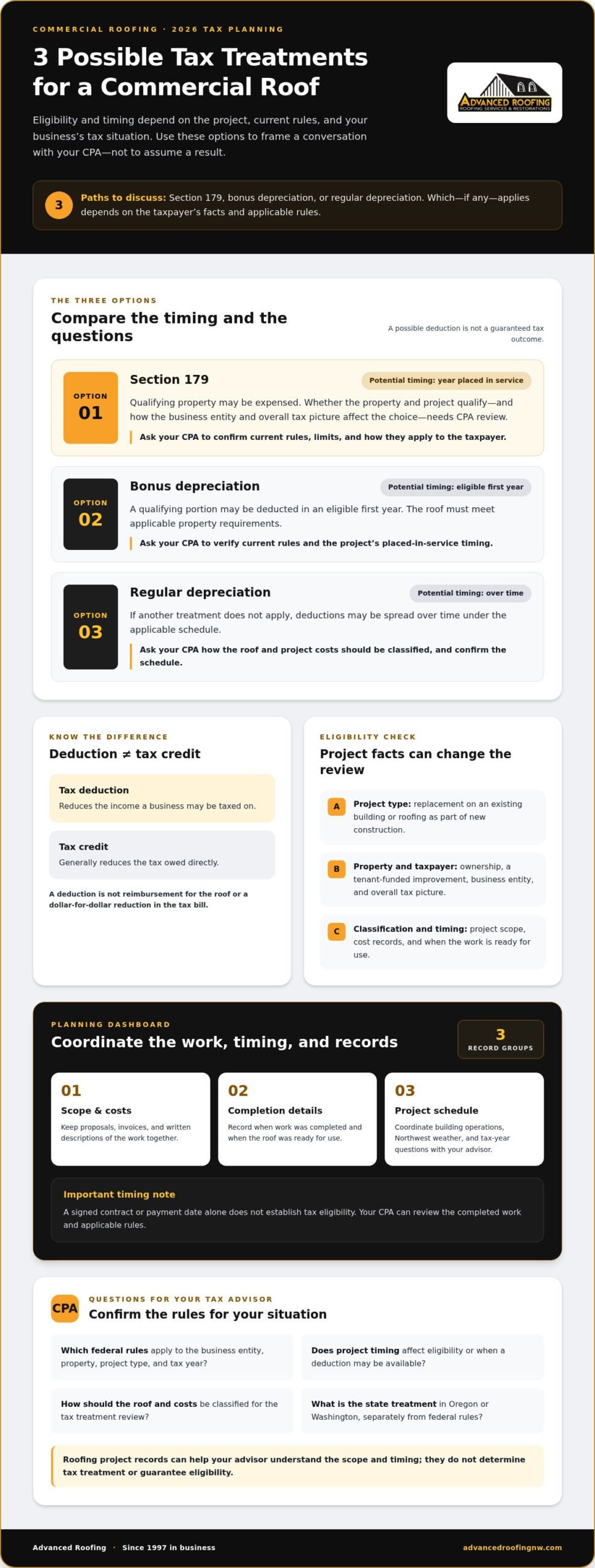
Depending on the facts and applicable rules, a business may discuss Section 179, bonus depreciation, or regular depreciation with its CPA. Section 179 may allow qualifying property to be expensed, while bonus depreciation may provide a first-year deduction for eligible property. If neither treatment applies, regular depreciation may spread the deduction over time. Eligibility and timing requirements can vary, so don’t assume a particular method applies to your roof.
Does a new roof on an existing commercial building qualify?
A roof replacement on an existing building and roofing installed as part of new construction can raise different project classification and tax questions. Ownership matters too: a business that owns the property may face different circumstances from a tenant funding improvements to a leased building. Your CPA may also need to review the project scope, how costs are documented, and when the work is ready for use.
Eligibility depends on current rules and the taxpayer’s facts. A new roof doesn’t automatically qualify for a particular deduction or immediate write-off. Ask your CPA to assess the project under current federal rules and separately review state treatment in Oregon or Washington. Advanced Roofing can provide a clear description of the project scope and completion details for your tax advisor. Those records support the review but don’t determine the tax result.
Compare commercial roof tax treatments before making a 2026 decision
There isn’t one tax treatment that fits every roofing project. Section 179, bonus depreciation, and regular depreciation each have eligibility and timing considerations. The right comparison depends on the taxpayer’s situation. Use this table to organize questions for your CPA, not to assume a particular outcome.
| Tax treatment | Eligibility questions | Possible timing | CPA verification |
|---|---|---|---|
| Section 179 | Does the property and project qualify, and how does the business’s entity and overall tax picture affect the choice? | A qualifying deduction may be available in the year the property is placed in service. | Confirm current rules, limits, and how they apply to the taxpayer. |
| Bonus depreciation | Does the roof meet the applicable property requirements? | A qualifying portion may be deducted in an eligible first year. | Verify current rules and the project’s placed-in-service timing. |
| Regular depreciation | How should the roof and project costs be classified? | Deductions may be taken over time under the applicable schedule. | Confirm the schedule and treatment for this property. |
Even when a deduction applies, it reduces taxable income. It isn’t reimbursement for the roof or a guaranteed amount of tax savings. Keep that distinction in mind when evaluating tax deductions for new commercial roofs 2026.
What should a business owner ask a CPA about the 2026 rules?
Ask which federal rules apply to your business entity, property, project type, and tax year, and whether the project’s timing affects eligibility. Request a separate review of Oregon or Washington treatment rather than assuming it matches federal rules. For practical context on local roof systems and project considerations, consult A Guide to Commercial Roofing in Portland & Vancouver.
As you compare tax approaches, make sure the roofing plan is clearly defined. Advanced Roofing can document the project scope and completion details for your tax advisor. Learn more about commercial roofing project planning.
Plan a commercial roof project around documentation, timing, and local conditions
A well-organized project makes it easier to coordinate the roofing work and give your CPA useful records. Start by assessing the roof’s condition and the building’s operational needs. Define the work to be done, then coordinate a schedule that accounts for building use and Northwest weather. Share the scope and schedule with your tax advisor before making assumptions about the tax year. A signed contract or payment date alone doesn’t establish tax eligibility. Your CPA can review the completed work and applicable rules.
Keep project paperwork together from planning through completion. Save proposals, invoices, written scope descriptions, and records showing when the work was completed and the roof was ready for use. Clear documentation helps your advisor understand what work was performed and when, without asking the roofing contractor to determine your tax treatment. For additional local roofing context, see Choosing the Best Commercial Roofing Contractors in Portland, OR: 2026 Buying Guide.
How Advanced Roofing can support commercial project planning
Advanced Roofing provides commercial roof replacements, new construction roofing, inspections, and TPO, PVC, and EPDM membrane systems. We document the agreed scope and project completion details so you can share a clear record with your tax advisor. These details may help your CPA review tax deductions for new commercial roofs 2026, but they don’t guarantee eligibility or a particular result.
Share your intended schedule and building requirements early, then keep the project records with your tax documents. Advanced Roofing serves businesses in Vancouver and the surrounding region, including Battle Ground, Camas, Ridgefield, La Center, Longview, Kelso, Woodland, Castle Rock, and Kalama, as well as the Portland metro area. Learn more about planning a commercial roofing project with our team.
Set your next roofing decision up for success
Tax planning is one part of a sound roofing decision. Your building’s condition, day-to-day operations, and project schedule deserve equal attention. Keep your CPA and roofing team aligned as plans take shape, and treat tax deductions for new commercial roofs 2026 as a question for professional review, not a promised outcome.
Advanced Roofing is a family-owned and operated company serving customers since 1997. We are fully licensed, bonded, and insured in Oregon and Washington, and provide commercial roofing services across the region.
Start planning your commercial roofing project with Advanced Roofing. Define the work, align the schedule, and keep clear records for your tax advisor.
Frequently Asked Questions
Is a new commercial roof tax-deductible in 2026?
Possibly. Some commercial roofing projects may qualify for a tax treatment under the rules in force for the relevant tax year, but installing a new roof doesn’t establish eligibility on its own. For tax deductions for new commercial roofs 2026, have a qualified tax professional review the ownership structure, project records, and how the work is classified. Don’t build a budget around a deduction until that review is complete.
Can a business use Section 179 for a commercial roof replacement?
Section 179 is one potential option to discuss with a CPA, not an automatic write-off for every roof replacement. Ask your advisor to verify whether the property and project qualify, which current-year limits apply, and how the deduction interacts with the business’s broader tax situation. Bring the planned scope and cost records to the discussion, and ask what alternatives may apply if Section 179 isn’t available.
When does a commercial roof need to be completed to count for the 2026 tax year?
Timing may hinge on when qualifying property is placed in service, rather than the date a contract is signed or an invoice is paid. For example, a project that carries into another tax year could raise different timing questions from work completed and ready for use within one year. Ask your tax professional how the rules define readiness and which records can support the relevant date.
Does federal tax treatment for a commercial roof also apply in Oregon and Washington?
Don’t assume federal treatment automatically governs state filings. Oregon and Washington rules should be checked separately against current guidance and the business’s circumstances. This is especially relevant for owners with commercial properties in Vancouver, Battle Ground, Camas, Ridgefield, La Center, Longview, Kelso, Woodland, Castle Rock, or Kalama. A tax professional can review how each property’s location and ownership affect the analysis.