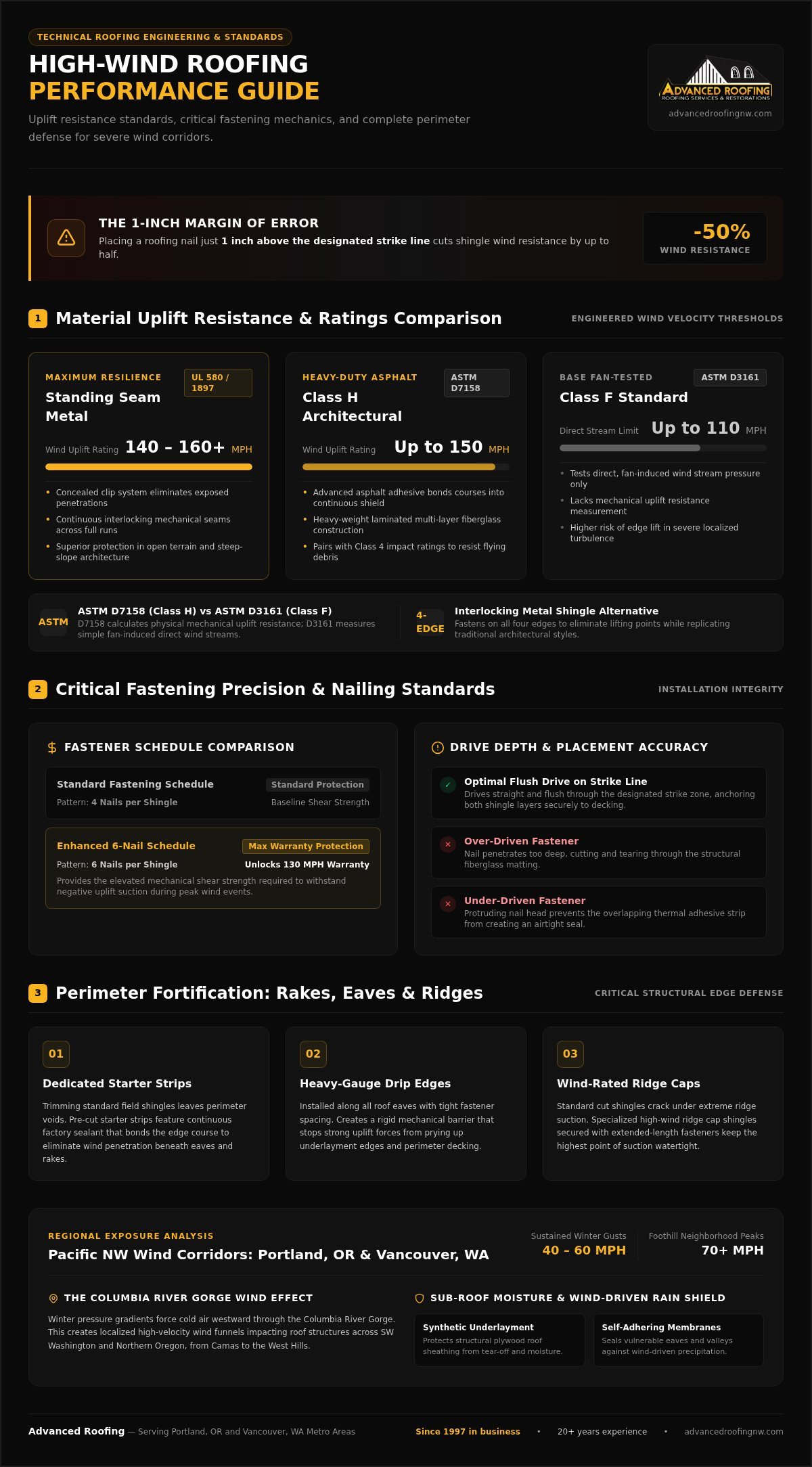
Placing a roofing nail just an inch above the designated strike line can cut a shingle’s wind resistance by up to 50%. The truth is that finding the best roofing materials for high wind areas requires looking beyond product labels to understand how materials and precision fastening work together.
There is nothing quite as stressful as listening to winter storm gusts batter your home while wondering if your shingles will peel away before morning. Sorting through complex ASTM ratings and manufacturer warranty limits only adds to the confusion. We will compare top wind-resistant materials, clarify how they perform against severe uplift, and explain the essential installation techniques that keep them anchored. Here is your complete guide to selecting a storm-ready roofing system that delivers lasting peace of mind.
Key Takeaways
- Explore how Class H shingles and standing seam metal rank among the best roofing materials for high wind areas to match your home’s exposure.
- Decode ASTM wind performance ratings so you can distinguish between fan-induced testing and real-world mechanical uplift resistance.
- Discover why an enhanced six-nail fastening schedule and factory starter strips are vital for maintaining full wind warranty protection.
- Learn how Columbia River Gorge wind corridors create intense localized gusts across Portland, OR and Vancouver, WA that demand specialized underlayment.
Comparing the Best Roofing Materials for High Wind Resistance
Severe storms do not just push against a building; they generate negative pressure. As high winds rush over your roof, they accelerate across the eaves, ridges, and corners, creating a powerful vacuum that pulls materials upward. Evaluating the best roofing materials for high wind areas requires understanding how different products counteract this mechanical uplift force.
- Class H Architectural Shingles: Tested under ASTM D7158, these shingles withstand uplift forces equivalent to wind speeds up to 150 mph. They rely on advanced asphalt adhesives that bind courses into a continuous protective shield.
- Standing Seam Metal: Engineered with concealed clips and continuous interlocking seams, standing seam panels resist uplift pressures tied to gusts between 140 and 160+ mph under UL 580 and UL 1897 standards.
- Interlocking Metal Shingles: These offer the textured look of traditional materials while fastening on all four edges to eliminate lifting points.
Performance Breakdown: Architectural Shingles, Metal, and Composite Systems
Testing standards tell the real story. While ASTM D3161 Class F tests direct, fan-induced wind stream pressure up to 110 mph, ASTM D7158 Class H measures the physical uplift resistance needed during severe turbulence. For maximum resilience, look for premium heavy-weight laminated shingles paired with Class 4 impact ratings to handle flying debris. Standing seam metal eliminates exposed fasteners, giving it an edge over standard shingles in open terrain.
Your home’s architecture also influences vulnerability. Steep slopes catch more lateral wind force, whereas broad overhangs and standard gable roof geometry experience intense suction along rakes and ridges. Matching the right material to your specific roofline ensures reliable protection.
Critical Installation Practices That Prevent Roof Wind Uplift
Even the best roofing materials for high wind areas will fail if they are poorly secured. Shingle blow-offs rarely stem from product defects; they happen because fasteners miss the structural reinforcement zone. Nailing into the manufacturer-designated strike line anchors both shingle layers firmly against the roof deck.
Precision fastening protects against severe lateral forces through specific techniques:
- Enhanced Six-Nail Fastening: Upgrading from the standard four-nail pattern to six nails per shingle provides the shear strength required for maximum 130 mph warranty ratings.
- Dedicated Starter Strips: Trimming regular shingles for edge courses leaves gaps. Using pre-cut starter strips with continuous factory sealant locks down the rakes and eaves, stopping wind from getting underneath.
- Proper Drive Depth: Fasteners driven too deep tear through the fiberglass mat, while under-driven heads prevent the adhesive strip above from sealing tight.
Key Components for Securing Roof Edges, Rakes, and Ridges
Perimeter details bear the brunt of storm pressures. Installing heavy-gauge metal drip edges along eaves with tight fastener spacing keeps wind from prying up underlayment edges. Along the ridge, where uplift suction peaks, standard shingles will crack under strain; installing specialized, wind-rated ridge caps secured with longer nails keeps the crest watertight.
If severe weather lifts an edge or dislodges material, arranging prompt roof repair services prevents exposed decking from soaking up moisture. When you want peace of mind about your home’s perimeter details, our certified team at Advanced Roofing can review your installation needs.
Selecting Storm-Ready Roofing for the Portland and Vancouver Metro Area
Living near the Columbia River Gorge brings unique weather patterns to Southwest Washington and Northern Oregon. Winter pressure gradients push cold air west through the gorge, producing sustained gusts of 40 to 60 mph that can peak past 70 mph in exposed foothill neighborhoods. When evaluating the best roofing materials for high wind areas in our region, stopping wind-driven rain is just as essential as resisting uplift.
Combining wind-resistant shingles with synthetic underlayment provides a crucial defense for vulnerable plywood roof sheathing. Installing self-adhering membranes along eaves and valleys ensures that moisture cannot reach your sub-roof, even during relentless seasonal storms.
Protecting Homes Across Vancouver, WA and Portland, OR
Since 1997, Advanced Roofing has served the Portland, OR and Vancouver, WA metro areas. We know firsthand how gorge winds challenge rooflines from Camas to the West Hills. When you schedule a roof replacement in Vancouver, WA or Portland, working with certified professionals safeguards your investment.
As an Owens Corning Preferred Contractor and Malarkey Certified Residential Contractor, our team follows exact application guidelines to secure full manufacturer wind warranties. Choosing the best roofing materials for high wind areas gives you lasting peace of mind when backed by certified local craftsmanship.
Build Lasting Protection for Your Northwest Home
Protecting your roof against severe weather requires the right combination of durable materials and precise installation techniques. Selecting the best roofing materials for high wind areas, such as Class H architectural shingles or standing seam metal, provides a strong first line of defense. When paired with six-nail fastening schedules and dedicated starter courses, your roof remains secure against intense uplift forces year after year.
Since 1997, Advanced Roofing has delivered dependable craftsmanship to neighborhoods across Vancouver, WA and Portland, OR. Our licensed, bonded, and insured team holds certifications as an Owens Corning Preferred Contractor and PABCO Preferred Pro Contractor. Schedule your free on-site estimate with Advanced Roofing today, and let us help you protect your investment with confidence.
Frequently Asked Questions
What shingle wind rating is recommended for high wind zones?
Homeowners in storm-prone regions should look for shingles carrying both an ASTM D7158 Class H rating and an ASTM D3161 Class F rating. This dual certification ensures the shingle has passed rigorous testing against mechanical uplift pressures up to 150 mph and direct, fan-induced winds reaching 110 mph. These standards guarantee the highest level of wind defense available for residential asphalt products.
Can architectural asphalt shingles withstand 130 mph wind speeds?
Yes, premium architectural laminated shingles can reliably handle 130 mph gusts when installed according to strict manufacturer guidelines. These heavy-duty options are among the best roofing materials for high wind areas because their multi-layered design resists tearing. To qualify for that top wind resistance, installers must secure each shingle using an enhanced six-nail fastening schedule rather than the basic four-nail pattern.
Why do roof shingles blow off during severe winter storms?
Shingles blow off primarily due to improper fastening, weakened sealants, or compromised starter strips along the eaves. Cold temperatures reduce asphalt adhesive pliability, preventing individual courses from bonding securely before seasonal storms hit. When installers place nails too high above the reinforcement line, strong wind suction easily levers the unanchored shingle layer away from the roof deck, initiating widespread perimeter damage.
How does roof pitch impact wind resistance and uplift vulnerability?
Roof pitch dictates whether a home faces direct wind impact or severe aerodynamic suction. Low-slope roofs experience immense upward suction forces across their entire surface, while steep slopes deflect upward draft but absorb heavy direct horizontal pressure. In neighborhoods across Vancouver and Camas, hip roof profiles distribute this pressure far better than wide gable profiles, making them naturally more resilient against high gusts.