
The lowest commercial roofing bid can become the more expensive choice over time. A commercial roof life cycle cost analysis looks beyond the initial proposal to compare the full cost of ownership, including maintenance, energy use, and eventual removal and replacement. That broader view matters when bids use different scopes or assume a service life that may not match your building or the Pacific Northwest climate.
It’s reasonable to start with the installation price, but a fair comparison also needs consistent assumptions. This article explains which costs to include, how to compare proposals on equal terms, and how to weigh system performance against your building’s needs and planning horizon. You’ll also see why project-specific details matter when evaluating TPO, PVC, and EPDM options for a commercial roof replacement or new installation.
Key Takeaways
- Use a commercial roof life cycle cost analysis to compare ownership over a planning period that reflects your building’s needs.
- Keep expected service life, warranty coverage, and marketing claims distinct when weighing roofing options.
- Align proposal scopes and assumptions so the comparison reflects equivalent work and planned costs.
- Use documented evidence, local exposure, and building operations to choose an installation or replacement approach that fits.
What a commercial roof life cycle cost analysis should, and should not, tell you
A commercial roof life cycle cost analysis estimates the project cost plus relevant ownership costs over a clearly stated period. That period matters: the comparison should reflect how long you expect to own or operate the building, not an arbitrary timeline. The broader Life-cycle cost analysis (LCCA) definition offers a useful foundation, but a roof analysis still needs assumptions that fit the property.
For a commercial roof replacement or installation, account for the proposed system and scope, the building’s use and current condition, and local exposure. Rain, wind, and damp conditions are part of the project context in Vancouver and the wider Pacific Northwest, but they don’t establish a universal service life for every roof.
Why lowest initial bid and longest claimed life are not enough
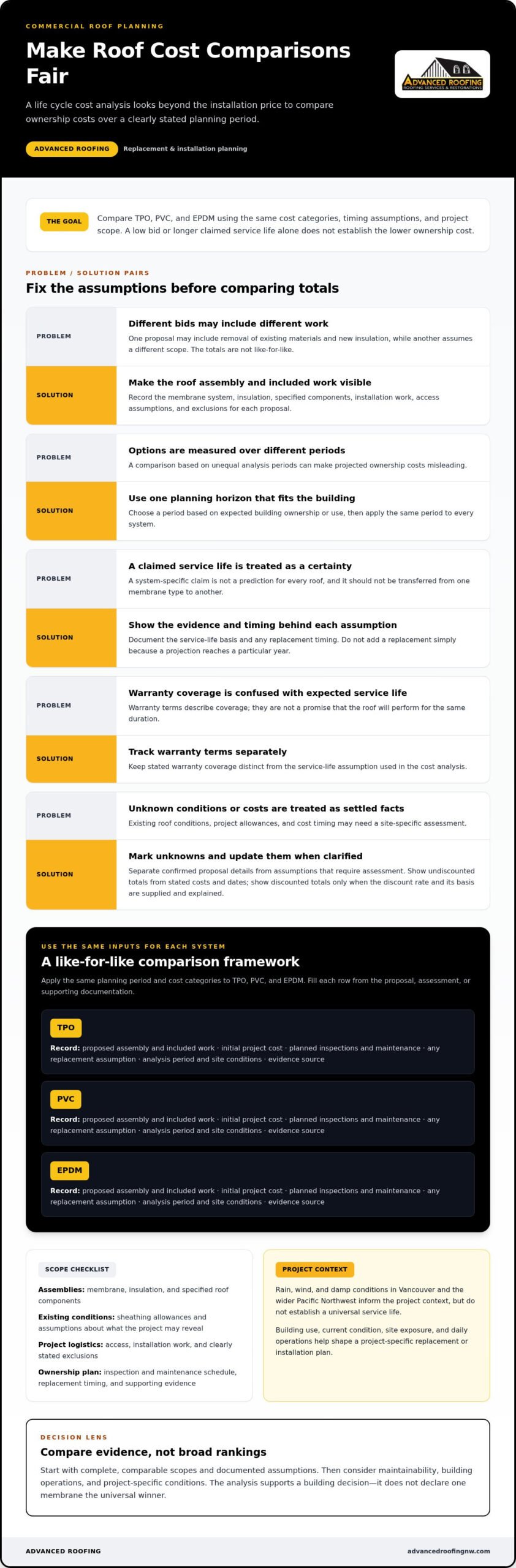
A low bid may cover a different scope than a higher one. One proposal might include removal of existing materials and new insulation, while another may assume different work. If the analysis periods or included work don’t match, the totals aren’t a fair comparison.
Likewise, a longer claimed service life doesn’t automatically mean lower ownership cost. A claim tied to EPDM, for example, shouldn’t be applied to TPO or PVC, or treated as a prediction for every EPDM roof. System, installation, building conditions, and exposure all matter. A warranty is also distinct from expected service life: its stated terms describe coverage, not a promise that the roof will perform for the same duration.
Treat each estimate as a planning tool, not a guarantee. Record the scope, time horizon, service-life basis, and ownership-cost assumptions, then compare them with the specific building and proposal. This gives you a clearer view of what the analysis can support and where uncertainty remains. Established contractors such as B Denson Roofing Ltd similarly emphasize that clear project scopes and realistic maintenance expectations are essential to managing overall roofing costs.
How to compare commercial roof life cycle costs with consistent assumptions
Start by choosing a planning horizon that fits the building’s expected ownership or use, then apply that same period to TPO, PVC, and EPDM. A commercial roof life cycle cost analysis is only useful when each option uses comparable cost categories and timing. The Detailed LCCA method for building design alternatives provides a framework for organizing costs across a building system’s life.
For each system, record the installation scope, scheduled inspections, planned maintenance, and any eventual replacement assumed within the analysis period. Don’t add a replacement simply because a projection reaches a certain year. Show the service-life evidence and timing assumption behind it. You can present undiscounted totals using stated costs and dates. Show discounted totals only when the discount rate and its basis are supplied and clearly explained.
Build a like-for-like comparison from the roof scope
Before comparing totals, make the scope visible. Separate confirmed proposal details from items that need a site-specific assessment, such as existing conditions or allowances. A compact worksheet can keep the options aligned:
- Assemblies: membrane system, insulation, and other specified roof components.
- Existing conditions: roof sheathing condition allowances and assumptions about what the project may reveal.
- Project logistics: access assumptions, installation work, and clearly stated exclusions.
- Ownership plan: inspection and maintenance schedule, replacement timing, and the evidence supporting each assumption.
Mark unknowns rather than treating them as settled costs. This makes the comparison easier to update when a site assessment clarifies the scope. For additional context on evaluating project proposals, use this commercial roofing contractor buying guide. Advanced Roofing plans commercial roof replacements and installations around each building’s needs. Explore commercial roof replacement planning.
Use the analysis to choose a commercial roof replacement or installation
A comparison should support a building decision, not declare one membrane the universal winner. Use the same categories for each option, then consider how the roof’s exposure and the building’s daily operations shape the project. In Vancouver and nearby communities, site conditions and facility use can affect which scope and installation plan makes sense. They don’t justify assuming a specific cost or performance outcome.
This worksheet keeps the decision grounded in proposal details and traceable evidence:
| System | Scope | Initial project cost | Planned ownership costs | Assumptions | Evidence source |
|---|---|---|---|---|---|
| TPO | Enter proposed assembly and included work | Enter proposal amount | List planned inspections, maintenance, and replacement assumptions | Record analysis period and site conditions | Proposal, assessment, or supporting documentation |
| PVC | Enter proposed assembly and included work | Enter proposal amount | List planned inspections, maintenance, and replacement assumptions | Record analysis period and site conditions | Proposal, assessment, or supporting documentation |
| EPDM | Enter proposed assembly and included work | Enter proposal amount | List planned inspections, maintenance, and replacement assumptions | Record analysis period and site conditions | Proposal, assessment, or supporting documentation |
Turn the cost comparison into a practical project decision
Look first for complete, comparable scopes and clearly documented assumptions. Then weigh maintainability and fit with building operations, including how project work can be coordinated with the facility’s needs. If the existing roof’s condition, proposed assembly, or new-construction design calls for details beyond a generic material comparison, use a project-specific assessment rather than relying on a broad ranking. That’s where a commercial roof life cycle cost analysis becomes a practical planning tool.
Advanced Roofing works with local owners on commercial roof replacements and installations, shaping the project scope around the building. For a project-specific starting point, request Free Roof Replacement Estimates.
Put Your Roof Plan Into Motion
Use your commercial roof life cycle cost analysis as a decision record. Keep its planning horizon and assumptions visible as building priorities evolve. A clear basis helps owners explain why a replacement or new installation fits the facility, even as operating needs change. The goal isn’t to predict every future condition; it’s to make a sound choice with the information available and a scope that reflects the building.
Advanced Roofing is a family-owned and operated company serving commercial projects with TPO, PVC, and EPDM membrane systems. The company has served the region since 1997 and is fully licensed, bonded, and insured in Oregon and Washington. Advanced Roofing serves Vancouver, Battle Ground, Camas, Ridgefield, La Center, Longview, Kelso, Woodland, Castle Rock, and Kalama. If a replacement is on your horizon, request an estimate for your commercial roof replacement and take the next step with a project-specific plan.
Frequently Asked Questions
Does a longer commercial roof warranty mean a lower life cycle cost?
No. Warranty length alone doesn’t show what the roof will cost to own. Review the written terms to see which components and conditions are covered, what exclusions apply, and whether coverage depends on specific requirements. For example, a longer material warranty may not cover installation workmanship or scheduled inspections, so it shouldn’t replace those costs in your comparison.
Can I use a manufacturer’s published roof lifespan in my cost analysis?
Yes, as a planning reference, not a guaranteed replacement date. Check that the published figure applies to the specific membrane and assembly under consideration, then compare it with the building’s documented condition, use, and exposure. Keep the source and any qualifications with your estimate. If the building differs from the conditions behind the claim, reflect that uncertainty rather than treating the lifespan as certain.
Should energy costs be included in a commercial roof life cycle cost analysis?
Include them when you can connect a credible energy estimate to the roofing option being evaluated. Use the building’s utility history and clearly documented assumptions about energy use, rather than assuming a membrane will produce a particular saving. If reliable, comparable estimates aren’t available, show energy costs separately or leave projected differences out so they don’t distort the commercial roof life cycle cost analysis.
How often should a commercial roof life cycle cost analysis be updated?
There’s no universal update interval. Revisit the analysis when a decision could change, such as a revised replacement scope, new roof assessment findings, a shift in building operations, or a changed ownership horizon. For owners with properties in Vancouver, Battle Ground, Camas, Ridgefield, La Center, Longview, Kelso, Woodland, Castle Rock, or Kalama, keeping assumptions current can support clearer planning across local facilities.