Waiting for a visible leak to address your facility’s aging roof often doubles your total investment before the first new material is even laid. We understand that budgeting for a commercial roof replacement cost in the Portland or Vancouver metro area feels like a moving target, especially with our unique regional moisture challenges and the fear of hidden structural damage during a tear-off. You need a solution that protects your business for the next thirty years, not just the next rainy season.
This guide provides the clarity you need to plan your 2026 capital expenditures with confidence, focusing on long-term value rather than just a quick fix. We’ll explore current pricing trends for common systems like TPO and EPDM while highlighting the specific local factors that impact your ROI in our damp Northwest climate.
Key Takeaways
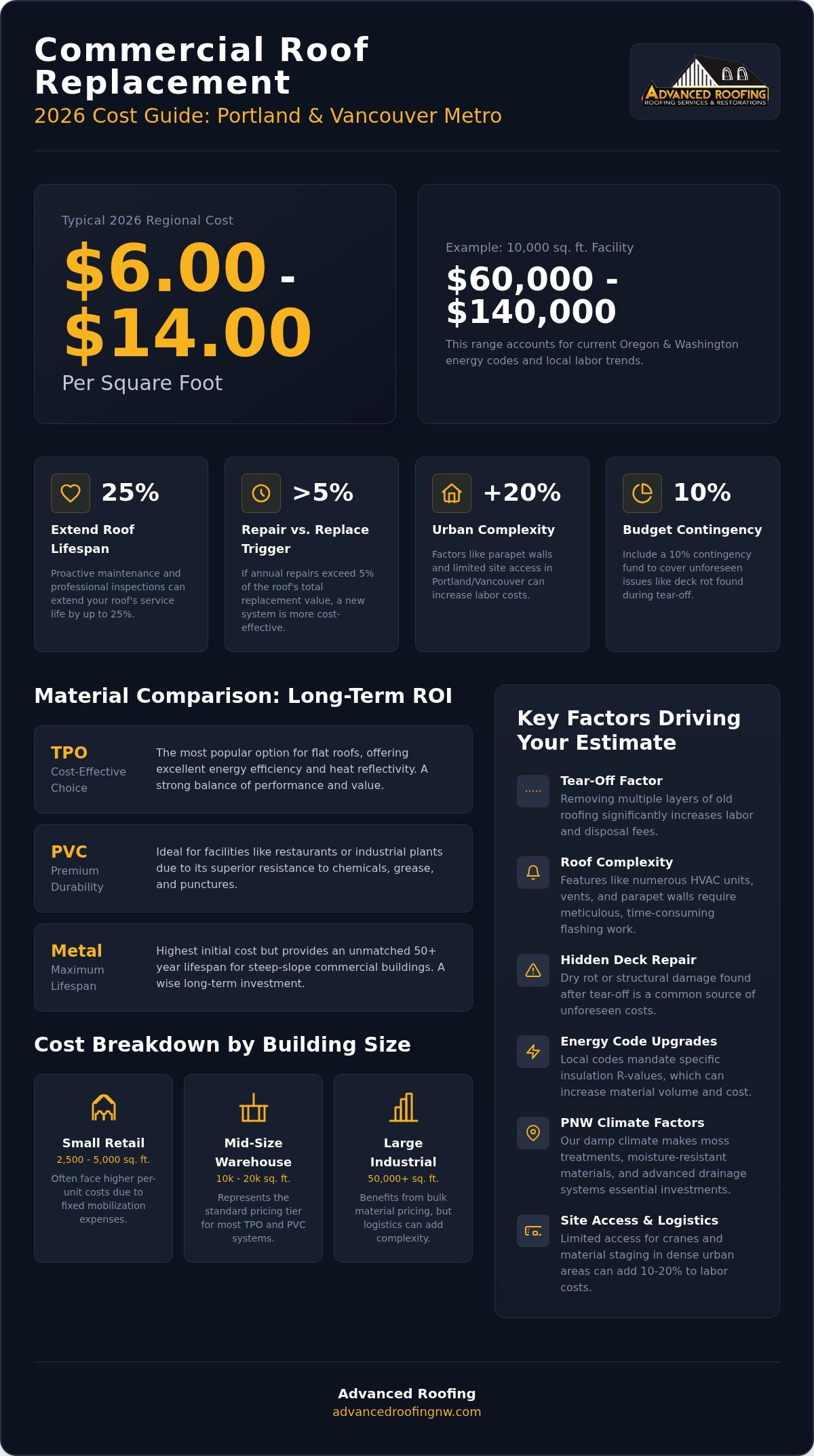
- Budget with confidence by understanding that a commercial roof replacement cost in 2026 typically ranges from $6.00 to $14.00 per square foot.
- Account for local complexity factors like parapet walls and site access that often increase labor costs by up to 20% in urban Portland and Vancouver.
- Evaluate the “tear-off” factor early to avoid unexpected expenses related to removing multiple layers of old roofing material.
- Protect your long-term investment by learning how proactive maintenance and professional inspections can extend your system’s life by up to 25%.
Average Commercial Roof Replacement Costs in 2026
Accurate budgeting starts with understanding the current market. For 2026, the average commercial roof replacement cost in our region falls between $6.00 and $14.00 per square foot for standard systems. For instance, a 10,000 square foot facility typically involves an investment of $60,000 to $140,000. These 2026 rates account for evolving Oregon and Washington energy codes and local labor trends in the Portland-Vancouver metro area. Getting a tailored new roof estimate ensures you account for your building’s specific footprint and insulation needs.
Cost Breakdown by Commercial Building Size
Scale significantly influences your project’s economics. Small retail spaces (2,500 to 5,000 sq. ft.) often face higher per-unit costs because fixed expenses like equipment mobilization are distributed over less square footage. Mid-size warehouses (10,000 to 20,000 sq. ft.) represent the standard pricing tier for TPO and PVC systems. Large-scale industrial facilities (50,000+ sq. ft.) benefit from bulk material purchasing, though complex logistics and safety staging can add to the labor total.
Material Comparison: TPO, PVC, and Metal
Your choice of material defines your long-term ROI. TPO is the popular, cost-effective choice for flat roofs, offering excellent reflectivity and heat management. For facilities like restaurants that deal with grease or chemicals, PVC provides the necessary chemical resistance and premium durability. Metal roofing requires the highest initial commercial roof replacement cost but offers an impressive 50-year lifespan for steep-slope commercial buildings, making it a wise long-term protection choice.
Key Factors That Drive Commercial Roofing Estimates
Estimating a commercial roof replacement cost involves more than a simple tape measure. The “tear-off” factor is a primary driver; if your building has multiple layers of old roofing, labor and disposal fees increase significantly. We also look at roof complexity. Features like parapet walls and HVAC units require meticulous flashing, while limited site access for cranes in dense urban areas can add 10% to 20% to your labor budget.
When a project involves disconnecting or relocating roof-mounted machinery, coordinating with a professional electrical contractor like Kingdom Electric ensures that your facility’s power systems are handled safely and efficiently during the construction process.
Local energy codes in Oregon and Washington now mandate specific R-values for insulation, which often increases material volume. If your flat roof suffers from ponding water, we must install tapered insulation to create a proper slope. These upgrades ensure your building remains dry and energy-efficient for decades.
The Hidden Costs of Roof Deck Repair
We sometimes find dry rot or structural damage only after removing the old system. Decking is the structural foundation of your roof that must be sound before installation. At Advanced Roofing, we handle these unforeseen issues with total transparency, providing clear documentation so you aren’t left guessing about the integrity of your investment.
PNW Climate Considerations
Our unique weather patterns make moss treatment and advanced drainage systems essential for commercial roofing in Portland. Investing in moisture-resistant materials now prevents the exponential repair costs often seen in the rainy Vancouver metro area. If you’re unsure about your current roof’s condition, our team can provide a professional assessment to help you plan your commercial roof replacement cost with accuracy.
Maximizing Your ROI: Planning and Budgeting for Success
Deciding when to transition from constant repairs to a full replacement is a critical business choice. While patching might seem cheaper today, repeating minor fixes often costs more over three years than a single commercial roof replacement cost. If you’re spending more than 5% of the roof’s total value on annual repairs, it’s time to invest in a new system. Proactive planning ensures you aren’t forced into an emergency replacement during the peak rainy season. Drier months offer smoother scheduling and fewer weather-related delays. Regular care remains the best way to protect your new system. A professional commercial roof inspection can extend your roof’s lifespan by up to 25%, delaying the next major capital expense.
Questions to Ask Your Commercial Roofer
Partnering with a family-owned contractor with 20 years of local experience provides peace of mind that national chains often lack. We treat your facility like our own. Before signing a contract, verify your roofer is licensed and bonded in both Oregon and Washington. Ask about their manufacturer certifications and the specific warranties that protect your materials and workmanship. You should also request a specific plan for how they’ll minimize noise and disruption to your daily business operations.
Finalizing Your Budget for 2026
Include a 10% contingency fund in your 2026 budget to cover potential structural repairs or deck rot discovered during tear-off. Always request a detailed, line-item estimate rather than a single lump sum. This transparency helps you understand the value of every dollar spent. Ready to protect your investment? Contact Advanced Roofing for a free commercial estimate today. Our team will help you navigate your commercial roof replacement cost with the integrity your neighborhood business deserves.
Securing Your Facility’s Future in the Northwest
Your roof is the first line of defense for your business, inventory, and team. Understanding the commercial roof replacement cost helps you move from reactive repairs to proactive protection. By accounting for local energy codes and the specific moisture challenges of the Portland and Vancouver metro areas, you ensure your investment lasts for decades. Our team focuses on providing long-term value through transparent communication and quality craftsmanship.
Advanced Roofing has served our local community since 1997. As a family-owned business with over 20 years of experience, we bring the integrity of a master craftsman to every project. We’re fully licensed, bonded, and insured in both Oregon and Washington to give you total peace of mind. Let’s work together to find the right material and budget for your facility. Get Your Free Commercial Roof Estimate today and take the first step toward a secure, dry future for your building.
Frequently Asked Questions
How long does a commercial roof replacement typically take?
A standard commercial project usually takes one to three weeks to complete. Smaller retail buildings might finish in just a few days, while larger industrial facilities or those with complex HVAC systems can take longer. We always provide a clear timeline before starting to help you manage your daily business operations without any surprises.
Can I install a new commercial roof over an existing one to save money?
You can sometimes install a new system over an existing one, which is known as a roof recovery. This approach reduces your initial commercial roof replacement cost by skipping tear-off and disposal fees. However, building codes in Portland and Vancouver usually limit roofs to two layers. We must also verify that the underlying deck is dry and structurally sound.
Does commercial insurance cover the cost of roof replacement?
Insurance typically covers the commercial roof replacement cost only if the damage results from a sudden, accidental event like a severe storm or fire. Policies don’t cover standard wear and tear or failures caused by neglected maintenance. We recommend reviewing your specific policy and scheduling a professional inspection to document any storm damage for your insurance carrier.
What is the best time of year to replace a commercial roof in the Pacific Northwest?
The ideal window for roofing in the Northwest is between late spring and early autumn. While our crews can install certain systems year-round, the dry weather from June through September allows for faster installations and safer tear-offs. Planning your project during these months helps avoid the logistical challenges and potential delays caused by our heavy regional rain.