A warehouse roof replacement in Longview, WA, is actually a complex logistics project disguised as a construction job. You’re likely balancing the need for a 20-year solution against the immediate fear of leaks damaging your inventory or a crew blocking your vital loading bays. It’s a significant investment, and with the 2021 Washington State Building Code now in full effect, getting the details right on 110 mph wind speed requirements and energy efficiency is more critical than ever.
We understand that your primary goal is to keep the facility operational while securing long-term protection for your assets. This guide provides a clear roadmap for handling the 2026 commercial landscape, from managing the 3 to 5 week permit review period in Longview to choosing materials that can lower cooling costs by up to 30%. You’ll learn how to achieve a seamless replacement that respects your logistics schedule, meets every Cowlitz County requirement, and provides the peace of mind that only a true Northwest expert can deliver.
Key Takeaways
- Identify the critical threshold between localized repairs and full system failure by understanding how Longview’s high humidity impacts industrial insulation.
- Compare the durability and cost-effectiveness of TPO and PVC membranes to select the ideal material for a warehouse roof replacement in Longview, WA.
- Implement staging and debris management strategies that protect your expensive inventory and maintain access to loading docks throughout the project.
- Navigate the complexities of the 2026 Washington State Energy Code and Cowlitz County’s specific permitting requirements to ensure full structural compliance.
- Learn how specialized equipment and a community-focused approach minimize operational downtime for large-scale industrial facility upgrades.
Signs Your Longview Warehouse Needs an Immediate Roof Replacement
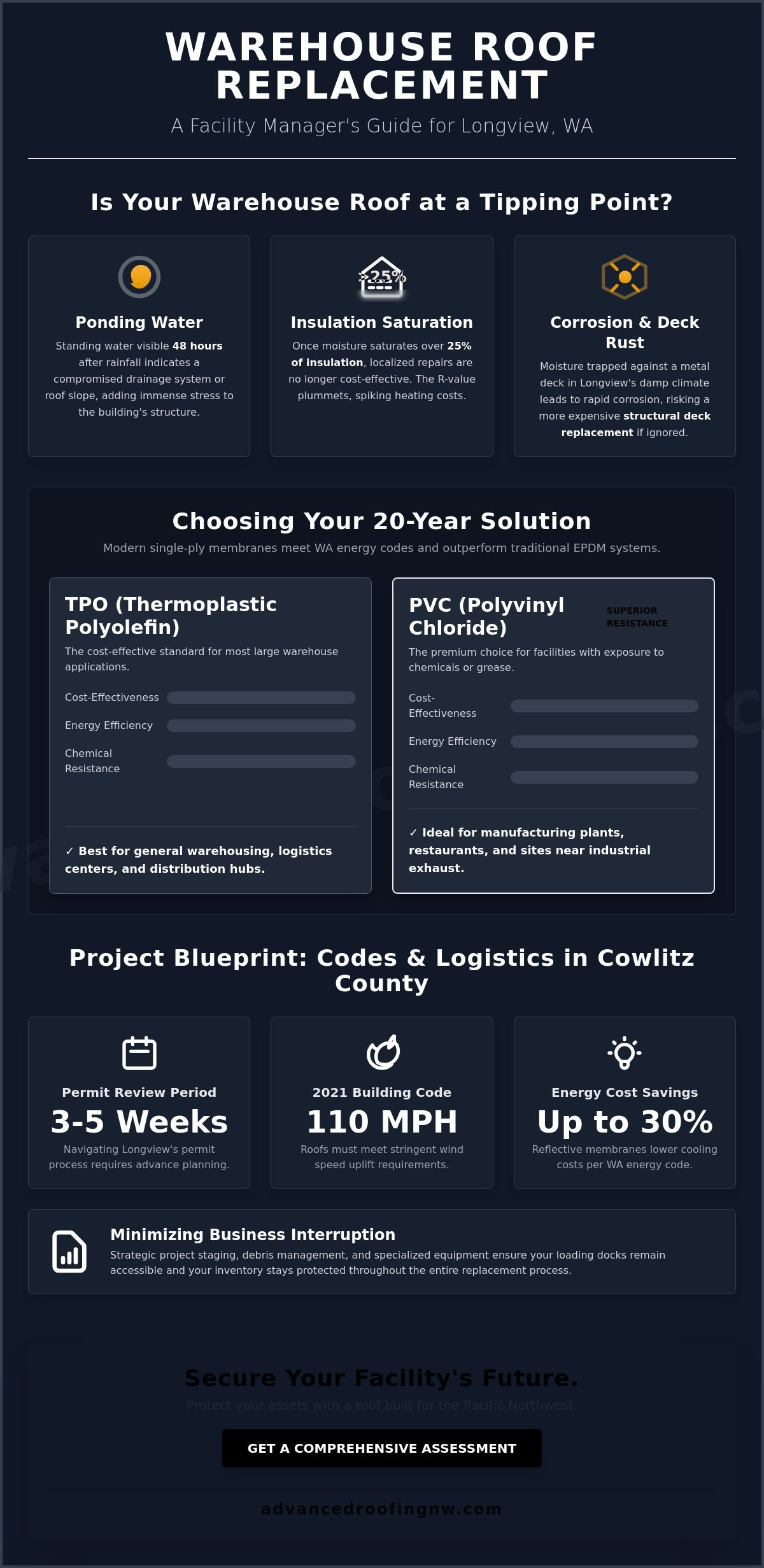
Deciding between a quick patch and a full warehouse roof replacement in Longview, WA, often comes down to what’s happening beneath the surface. In our humid Northwest climate, a roof system doesn’t just fail all at once; it degrades through a process of progressive saturation. When moisture bypasses the top membrane, it settles into the insulation layers. Once more than 25% of your roof’s insulation is wet, localized repairs are no longer cost effective. At this point, the roof acts like a giant sponge, holding water against your structural deck and inviting systemic failure.
Ponding water on large flat surfaces is a clear signal of a structural emergency. If you notice standing water 48 hours after a typical Cowlitz County downpour, your drainage system or the roof’s slope has likely been compromised. This weight puts immense stress on the building’s frame. Beyond structural concerns, a failing roof jeopardizes your most valuable assets: your personnel and your equipment. Drips onto polished concrete floors create immediate slip hazards, while leaks over high density racking can destroy thousands of dollars in inventory before you even notice the moisture.
Detecting Hidden Moisture and Insulation Saturation
We often use infrared thermography to identify trapped water that isn’t visible to the naked eye. Wet insulation loses its R-value rapidly, which spikes your warehouse heating costs during our cold, 22°F winter nights. To confirm these findings, core sampling serves as the gold standard for saturation testing, allowing us to see exactly how many layers of the commercially available roofing materials have been compromised. This data-driven approach ensures you aren’t replacing a roof that still has life, but it also prevents you from wasting money on temporary fixes for a terminal problem.
The Cost of Delay: Inventory and Structural Risks
Delaying a necessary replacement creates a breeding ground for mold, which can contaminate sensitive goods and trigger health concerns for your team. In Longview’s damp environment, moisture trapped against a metal deck leads to rapid corrosion and rust. If you catch these issues early, you might only need a roof repair in Vancouver, WA or Longview to extend the system’s life. However, ignoring active deck rust or widespread saturation eventually leads to a much more expensive structural deck replacement. Taking action now protects your investment and ensures your facility remains a safe, productive environment for your staff.
Top Commercial Roofing Materials for the Longview Climate
Selecting the right material for a warehouse roof replacement in Longview, WA, requires a deep understanding of our local industrial environment. Our region’s frequent rain and high humidity demand a system that does more than just shed water. It must also comply with the 2026 Washington State Energy Code, which places a heavy emphasis on solar reflectance. While traditional EPDM (rubber) roofing was once a staple, it’s becoming much less popular for Longview assets. EPDM’s black surface absorbs heat, and its glued or taped seams are more prone to failure in our damp climate compared to modern, heat-welded alternatives.
Most facility managers now look toward single-ply membranes like TPO and PVC as the modern standard for commercial roofing materials. These white or light-gray surfaces can reduce cooling costs by up to 30% during the summer months. This reflectivity isn’t just about comfort; it’s a primary way to meet the stringent energy efficiency standards required for new commercial installations. If your warehouse is located near industrial zones where chemical exhaust or grease is a factor, the specific type of membrane you choose will determine if your roof lasts 10 years or 25 years.
TPO vs. PVC: Which is Better for Your Facility?
TPO (Thermoplastic Polyolefin) is often the preferred choice for large warehouse footprints because it offers a great balance of cost-effectiveness and energy efficiency. However, if your operations involve chemical processing or nearby industrial emissions, PVC (Polyvinyl Chloride) provides superior resistance to oils and harsh chemicals. Both systems rely on heat-welded seams, which create a physical bond between sheets that is significantly stronger than the material itself, making them the ideal choice for resisting the relentless PNW rain.
The Benefits of Fluid-Applied Reinforced Roof Coatings
Sometimes, a full warehouse roof replacement in Longview, WA, isn’t the only answer. If your current roof is structurally sound but reaching the end of its manufacturer’s warranty, a fluid-applied reinforced coating can act as a “recovery” system. This process involves applying a seamless, waterproof membrane directly over the existing roof. It’s a sustainable choice that keeps heavy debris out of Cowlitz County landfills while providing a fresh, reflective surface. Many commercial roofing contractors in Portland and the surrounding metro area recommend this for facilities looking to extend their investment without a total tear-off. If you aren’t sure which path is right for your building, we can help you evaluate your options with a professional roof inspection.
Minimizing Business Interruption During Replacement
A successful warehouse roof replacement in Longview, WA, depends as much on logistics as it does on craftsmanship. We view your facility as an active hub of commerce, not a vacant construction site. Proper staging is the first step in protecting your daily operations. We coordinate the placement of heavy equipment, such as cranes and disposal containers, to ensure they never obstruct your primary loading docks or fire lanes. By maintaining clear access for your freight carriers, we keep your supply chain moving while we work overhead.
Debris management is another critical factor for industrial environments. Removing an old roof assembly can generate significant dust and fine particulates. We use specialized containment strategies to keep the interior of your warehouse environment dust-free, protecting sensitive electronics or packaging materials from contamination. Noise mitigation is equally important for your onsite administrative staff. We schedule high-impact tasks, like fastener installation into metal decks, during your team’s off-peak hours or staggered shifts to minimize the acoustic disruption in office areas.
Phased Replacement Strategies
We often break large-scale projects into manageable sections to maintain interior operations. This phased approach allows us to focus on one area at a time, keeping the rest of your facility fully functional. We work closely with warehouse managers to identify peak shipping schedules, adjusting our workflow to stay clear of the busiest zones. Safety remains our top priority, especially when roofing over active receiving bays. We establish clear exclusion zones on the ground, using physical barriers to manage the interaction between our crew and your forklifts. Every evening, we ensure the building remains watertight, protecting your inventory from the unpredictable Northwest rain before the crew leaves the site.
Internal Protection Systems
For facilities storing food-grade products or high-value inventory, we implement internal protection systems. This includes the use of vapor barriers and heavy-duty drop cloths to catch any minor debris that might fall through the deck during the tear-off phase. Communication is the engine that drives this process. Our roofing foreman holds daily briefings with your facility manager to discuss the day’s progress and any upcoming logistics shifts. To maintain air quality, we prioritize fume recovery systems during the application of adhesives. This ensures that your employees aren’t exposed to strong odors or volatile organic compounds while they work below.
Navigating Permits and Building Codes in Cowlitz County
Securing a permit for a warehouse roof replacement in Longview, WA, involves more than just filing paperwork; it’s about ensuring your facility meets the rigorous 2021 Washington State Building Code. Depending on your building’s exact location, you will work with either the Longview Building Division or the Cowlitz County Department of Building and Planning. Each has slightly different fee structures. For example, Longview’s plan review fee is typically 70% of the permit fee, while the county’s review fee is 65%. Getting these logistics right at the start prevents costly delays during the final inspection and warranty sign-off.
Wind uplift requirements are particularly strict for warehouses located near the Columbia River. The code mandates an ultimate design wind speed (Vult) of 110 mph. This means every component of your new roof system, from the fastener density to the edge flashing, must be engineered to withstand significant pressure. We ensure all documentation is ready for the building official, who has the authority to assess fees based on the fair market value of the project’s labor and materials. This thoroughness is why we recommend starting with a professional roof installation consultation to map out your compliance strategy.
Energy Code Compliance and R-Value Standards
The 2026 energy landscape requires modern industrial installs to meet high R-value standards through increased insulation thickness. “Cool roofs,” which use highly reflective membranes like TPO, are now the standard requirement in many Washington jurisdictions because they significantly reduce the urban heat island effect. While these requirements might seem like a hurdle, they often qualify your business for energy-efficient upgrades and incentives in the Longview area. We help you calculate the exact insulation depth needed to satisfy the 2021 Washington State Building Code while maximizing your long-term energy savings.
The Permitting Timeline for Commercial Projects
Typical wait times for commercial roof permit approval in Longview range from 3 to 5 weeks. This timeline can extend if your project requires structural engineering reviews, especially if you plan to install heavy rooftop HVAC units on a new membrane. While you are planning these regulatory steps, you can use our guide on new roof cost to understand general budgeting frameworks for large-scale projects. Having your structural data and material specifications ready when you apply will help streamline the review process and get your crew on the roof faster.
Why Advanced Roofing is Longview’s Trusted Commercial Expert
Selecting the right contractor for a warehouse roof replacement in Longview, WA, requires a partner who views your facility as more than just another job site. We understand that your roof is the primary shield for your inventory and your people. With a legacy spanning over 40 years in the Portland and Vancouver metro areas, we’ve built our reputation on the integrity of our workmanship. We don’t just install materials; we engineer solutions that survive the unique dampness and 110 mph wind speeds common to our corner of the Northwest. Our specialized crews use industrial-grade equipment to handle massive square footage with the same detail a master craftsman applies to a residential project. Our deep understanding of local rain patterns allows us to plan for the watertight standards that keep your operations moving even during the most aggressive Cowlitz County storms.
A Legacy of Craftsmanship and Integrity
Our family-oriented business model ensures a direct line of accountability from the first inspection to the final sign-off. We treat every project like it’s our own property. This means we never cut corners on the technical details that ensure long-term value. Being fully licensed, bonded, and insured in Washington isn’t just a requirement for us; it’s a foundation of the trust we build with our neighbors. We prioritize long-term relationships over quick transactions, providing comprehensive warranties that offer true peace of mind for facility owners. When we finish a project, we stand behind it because we’re part of this community too. This humble yet confident approach is what makes us a reliable resource for local industrial assets.
Get Your Free Longview Warehouse Roof Estimate
We’ve refined our estimation process to be as informative and helpful as possible. Our team conducts a detailed on-site assessment to identify the specific needs of your building’s structure and operations. We provide no-pressure consultations that focus on solving your facility’s challenges rather than hitting a sales quota. You’ll receive a logical, transparent plan that outlines the best materials and logistics for your unique situation. This professional consultation is the first step toward a durable, leak-proof future for your building. Our goal is to provide a clear path forward so you can make an informed decision for your investment. Schedule your free warehouse roof estimate today and experience the quality you can trust from a local expert.
Securing Your Facility’s Future in Longview
We’ve explored how to identify the critical point of moisture saturation and why selecting 2026-compliant materials like reflective TPO is essential for your bottom line. Successfully navigating a warehouse roof replacement in Longview, WA, requires a balance between strict Cowlitz County code compliance and the logistical needs of an active shipping hub. By prioritizing durable, heat-welded seams and high R-value insulation, you protect your inventory and ensure your building remains a high-performing asset for decades.
Advanced Roofing brings over 40 years of Northwest experience to your project. As certified commercial specialists who are fully licensed, bonded, and insured, we provide the stability and expertise your business deserves. We treat every industrial facility with the care of a local neighbor and the precision of a master craftsman. Get Your Free On-Site Warehouse Roof Estimate today to begin a partnership built on transparency and quality. We look forward to helping you shelter your business and your team with a roof designed for the long haul.
Frequently Asked Questions
How long does a warehouse roof replacement usually take in Longview?
A typical project for a large-scale facility usually takes between three to six weeks to complete from the start of the tear-off to the final inspection. This timeline depends on the building’s total square footage and the amount of rooftop equipment that needs to be flashed. We work in phases to ensure that only small sections of your building are open at any given time, which protects your operations from the unpredictable Northwest weather.
Can I replace my warehouse roof without moving my inventory?
You can definitely keep your facility operational and your inventory in place during a warehouse roof replacement in Longview, WA. We implement strict internal protection protocols, such as using heavy-duty vapor barriers and drop cloths to catch any dust or minor debris. Our team coordinates daily with your facility manager to schedule work over specific zones, ensuring that your loading docks and high-traffic shipping areas remain clear and safe.
What is the best roofing material for a flat commercial building in the PNW?
TPO and PVC are currently the most reliable materials for the damp and windy conditions of the Pacific Northwest. Both systems use heat-welded seams that are significantly stronger than taped or glued alternatives, providing a watertight seal against heavy rain. While TPO is often the most cost-effective choice for large footprints, PVC is the superior option for buildings that require high resistance to chemicals or industrial oils.
Does a new warehouse roof need to meet the 2026 Washington Energy Code?
Every commercial roof replacement must comply with the 2021 Washington State Building Code, which became the active standard on March 15, 2024. This code mandates specific insulation R-values and requires the use of reflective “cool roof” membranes in most industrial applications. Following these regulations isn’t just about legal compliance; it also significantly reduces your long-term heating and cooling expenses by improving the building’s thermal envelope.
How much does it cost to replace a 50,000 square foot warehouse roof?
The total investment for a 50,000 square foot roof varies based on the type of membrane selected and the current state of your roof deck. Factors like insulation thickness required by the 2026 energy codes and the complexity of existing drainage systems also influence the final valuation. We provide a professional roof inspection to give you a detailed, transparent estimate that reflects the specific logistical needs of your Longview facility.
What is the difference between a roof replacement and a roof coating?
A roof replacement involves a full tear-off of the existing membrane and insulation, while a coating is a fluid-applied reinforced system installed over your current roof. Coatings are an excellent “recovery” option if your roof structure is sound and the insulation is dry. However, if core sampling reveals that your insulation is saturated, a full replacement is the only way to restore the structural integrity and R-value of your facility.
Are there tax incentives for installing an energy-efficient commercial roof in WA?
Many businesses take advantage of federal Section 179 deductions, which may allow for the full cost of a commercial roof replacement to be deducted in the year of installation. In the Longview area, local utility providers also occasionally offer rebates for upgrades to reflective TPO or PVC systems that reduce peak energy demand. It’s best to consult with your tax professional to confirm the specific 2026 incentives available for your business.
How do I know if my warehouse roof deck is structurally sound?
We determine the condition of your roof deck through professional core sampling and infrared moisture surveys. These tools allow us to see through the top membrane and check for rust on metal decks or rot in wood structures. Identifying these issues early prevents small leaks from turning into major structural failures, ensuring that your new roof installation has a stable, reliable foundation that will last for 20 years or more.