Last November, a homeowner named Sarah in Vancouver discovered a dark, damp patch on her attic ceiling just as the first major storm of the season arrived. While she feared a total roof failure, the true culprit was a rusted, failing piece of metal that required a professional chimney flashing repair to stop the intrusion. It’s a common story across the Northwest. Dealing with active water damage is incredibly stressful, especially when you’re faced with confusing quotes that range from temporary sealant patches to entire roof replacements. You deserve a solution that actually stands up to the 42 inches of annual rainfall we see in Clark and Multnomah County.
We understand that protecting your family and your investment is your top priority. This guide will show you how to identify the early warning signs of a leak and why a permanent repair is the only way to ensure long-term protection against our damp climate. You’ll learn the difference between a quick fix and a master craftsman’s solution, as well as how to find a local contractor who truly understands the unique demands of Pacific Northwest weather. Let’s look at how to keep your home dry and secure for many seasons to come.
Key Takeaways
- Learn how to identify the early warning signs of flashing failure caused by the unique, persistent rain and wind patterns of the Pacific Northwest.
- Discover the three-part anatomy of a truly waterproof chimney and why “one-piece” shortcuts often fail in high-wind areas like the Columbia River Gorge.
- Master the “2-year rule” for sealants to determine if a professional chimney flashing repair is sufficient or if a full replacement is necessary for long-term protection.
- Understand the rigorous safety and removal steps required during a professional repair to ensure a seamless, watertight bond between your masonry and roof.
- Find out how partnering with a local, family-owned expert can safeguard your home’s integrity and ensure your roof meets specific Vancouver and Portland building codes.
Identifying Chimney Flashing Failure in the Pacific Northwest
Your chimney is one of the most vulnerable points on your roof. To keep your home dry, we rely on Flashing (weatherproofing). This is the critical metal seal that bridges the gap between your masonry chimney and the roofing shingles. In the Portland and Vancouver metro area, this seal faces a constant barrage of moisture. While flashing is designed to shed water, our unique Northwest climate often accelerates the wear and tear on these metal components. Most homes in our neighborhoods use galvanized steel for their chimney base. While durable, constant exposure to the 36 inches of rain Portland receives annually leads to oxidation. Once the protective zinc coating wears down, rust begins to eat through the metal. This creates pinhole leaks that are often invisible from the ground.
If you wait until you see a puddle, the internal structure may already have significant rot. Scheduling a professional chimney flashing repair early protects your home’s integrity and saves you from costly structural fixes later. We’ve seen many cases where a small gap in the metal led to thousands of dollars in attic damage because the leak went unnoticed for a single season. Our goal is to provide peace of mind by catching these issues before they compromise your family’s comfort.
Common Signs of a Flashing Leak
You don’t always need to climb a ladder to know there’s a problem. Keep an eye out for these red flags during our wet winters:
- Water stains: Look for brown or yellow discoloration on the ceiling or walls near the fireplace.
- Audible dripping: You might hear a steady rhythmic sound inside the chimney flue during a heavy Vancouver rainstorm.
- Surface damage: Visible rust or “pitting” on the metal surrounding the chimney base indicates the material has reached the end of its lifespan.
The PNW Moss Factor
In wooded areas like Ridgefield and Camas, moss is more than just an eyesore; it’s a structural threat. Moss thrives in the shade provided by your chimney, trapping moisture against the metal for months at a time. As moss grows, its root-like structures expand. These can actually lift the edges of your flashing, breaking the industrial-grade sealant underneath. When homeowners try to clear this debris themselves, they often find that the moss was the only thing “plugging” a hole created by corrosion. We’ve seen cases where a simple cleaning reveals flashing that is as thin as paper due to constant dampness. A proper chimney flashing repair ensures the metal is secure and the area is treated to prevent future growth from compromising the seal.
The Anatomy of a Waterproof Chimney: Step, Counter, and Base Flashing
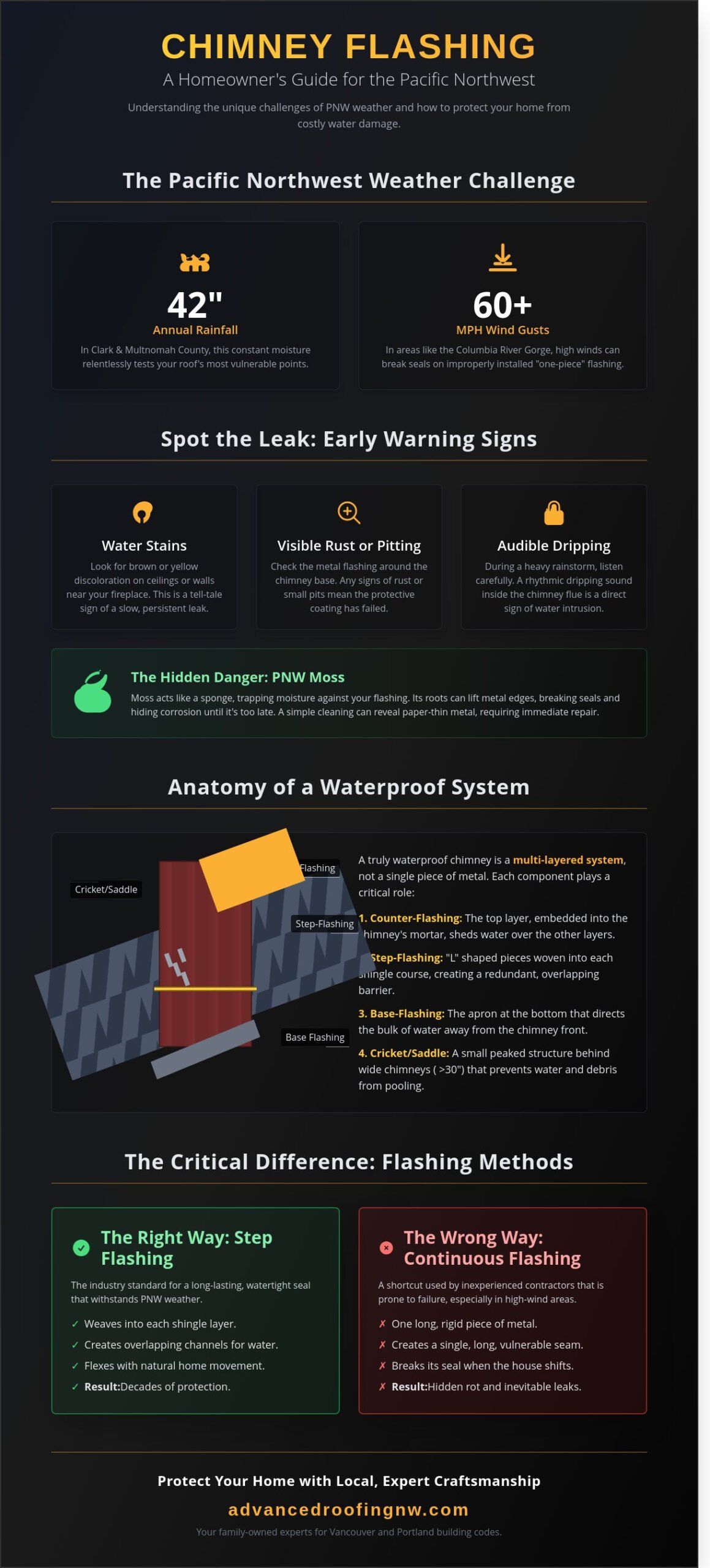
A truly waterproof chimney depends on a layered defense system. It’s not just about placing metal against a brick wall; it requires a three-part integration of base, step, and counter-flashing. This setup creates a mechanical bond between your roof deck and the masonry structure. In high-wind areas like the Columbia River Gorge, where gusts can exceed 60 mph, “one-piece” or continuous flashing systems frequently fail. These rigid pieces can’t handle the independent movement of your home’s timber frame and the heavy chimney stack. When the house shifts, the seal breaks. For any chimney wider than 30 inches, we also install a “cricket” or saddle. This peaked structure sits behind the chimney to divert water, preventing a “dead valley” where debris and gallons of runoff would otherwise pool during a heavy Northwest downpour.
Step Flashing vs. Continuous Flashing
Step flashing is the industry standard for shingle roofs in Battle Ground and across the Portland metro area. Our team weaves individual “L” shaped metal pieces into every shingle layer. This overlapping method ensures that if water gets past the outer edge, it’s immediately channeled back onto the shingle surface below. Continuous “L” flashing, often used by less experienced contractors, creates one long, vulnerable seam. On a sloped residential roof, this seam is a primary failure point because it doesn’t account for the natural expansion of building materials. This often leads to hidden rot that eventually requires professional chimney flashing repair to resolve.
The Role of Counter-Flashing
Counter-flashing provides the vital upper seal that keeps water from running behind the lower layers. We don’t just nail this metal to the brick. Our specialists perform a reglet saw cut, which means we “let” the metal into the mortar joints. This creates a permanent mechanical seal that gravity and wind cannot easily breach. Surface-mounted counter-flashing, which relies entirely on a bead of caulk, is a temporary solution at best. In a climate where Portland receives an average of 42 inches of rain annually, that caulk will eventually dry and crack. A proper reglet cut ensures your home stays dry for decades.
Material Selection: From Aluminum to Copper
Material choice dictates the lifespan of your roof’s most vulnerable point. Galvanized steel is common, but it can begin to rust after 15 years in our damp environment. Aluminum offers better corrosion resistance, though it’s more susceptible to physical damage. For historic Portland homes in neighborhoods like Laurelhurst or Irvington, copper flashing is the gold standard. It lasts 50 years or more and develops a protective patina over time. Advanced Roofing recommends 26-gauge metal for most residential projects. This thickness is heavy enough to resist wind uplift while remaining pliable enough for a precision fit during your next chimney flashing repair or roof replacement.
Chimney Flashing Repair vs. Full Replacement: A Homeowner’s Guide
Homeowners frequently ask if they can resolve a leak by simply applying a layer of roofing cement. While this provides a temporary fix, it rarely solves the underlying issue. In the Pacific Northwest, where Portland sees an average of 36 to 42 inches of rain annually, we apply the 2-year rule for sealant-based fixes. Because metal, brick, and wood expand and contract at different rates, a chimney flashing repair that relies only on topical sealants typically fails within 24 months. You want a solution that matches the durability of your home, not a recurring maintenance headache.
The decision to repair a single side or perform a full chimney wrap often depends on the age of your roof. If your roofing system was installed within the last 5 to 10 years, investing in high-quality copper or galvanized steel flashing is a wise way to protect your investment. However, if your shingles are 20 years old and nearing the end of their functional life, a targeted repair might be the most logical choice to keep the home dry until the entire roof is replaced. We always look at the big picture to ensure you aren’t spending money on a component that will be torn off in a few seasons.
When a Simple Repair is Sufficient
Our team often finds that a full replacement is overkill for minor issues. A professional chimney flashing repair is often enough when the metal itself remains structurally sound. We recommend a focused repair for these scenarios:
- Resealing minor cracks in the counter-flashing reglet where the original mortar or sealant has weathered away.
- Replacing a single piece of step flashing that was damaged or dislodged during a 50 mph windstorm.
- Cleaning and re-securing metal edges that have pulled away from the masonry due to house settling.
Signs You Need a Full Flashing Replacement
Sometimes, the damage is too deep for a simple patch. We see these issues frequently in older Portland neighborhoods where homes were built before 1975. You likely need a full replacement if you notice:
- Extensive rust that has created pinholes in the metal, a common sight on galvanized steel flashing that is over 20 years old.
- Flashing that was originally installed without being tucked directly into the mortar joints, leaving it prone to water bypass.
- Crumbling masonry or failing mortar that requires tuckpointing, as the flashing must be removed to fix the chimney structure properly.
We focus on providing the right fix for your specific situation. Whether it’s a minor adjustment or a complete overhaul, our goal is to ensure your home stays dry through the next rainy season. We treat every roof with the same care we’d give our own families’ homes.
The Professional Repair Process in Vancouver and Portland
Professional chimney flashing repair requires more than a ladder and a tube of caulk. Our team begins every project by installing OSHA-compliant fall protection systems. This is vital for the 8/12 and 12/12 roof pitches common in historic Portland neighborhoods like Irvington or Laurelhurst. We don’t take shortcuts with safety or your property. The first physical step involves removing the surrounding shingles. We strip back at least 12 to 18 inches of roofing material around the chimney base. This reveals the roof deck and allows us to inspect the wood for rot that often hides beneath the surface.
The Importance of Underlayment Integration
Modern roofing standards in the Northwest demand a multi-layered defense. We install self-adhering ice and water shields directly to the wood deck before any metal touches the roof. This synthetic membrane acts as a secondary waterproof barrier. It’s a critical step that roughly 35% of low-bid contractors skip to save on material costs. By bonding the underlayment to the chimney masonry, we ensure that even if a shingle fails during a windstorm, your attic stays dry. This “belt and suspenders” approach is the only way to provide long-term peace of mind in our climate.
Masonry and Mortar Work
A chimney flashing repair is only as good as the surface it attaches to. Advanced Roofing NW technicians examine the mortar joints for signs of crumbling or spalling. We use high-grade polyurethane sealants rather than the old-fashioned black tar used by less experienced crews. Polyurethane remains flexible during our 40-degree daily temperature swings; tar becomes brittle and cracks within 24 months. We often grind out old mortar to inset the counter-flashing, creating a mechanical seal that sheds water naturally using gravity.
Before we consider the project complete, we perform a controlled water test. We simulate a heavy Pacific Northwest downpour for 15 minutes to verify every lap and seal. This rigorous process ensures a 100% waterproof result before we ever leave the job site. We treat your roof with the same care we’d use on our own homes. If you are worried about the state of your roof, contact us for a free estimate to protect your investment.
Protecting Your Investment with Advanced Roofing’s Expert Craftsmanship
Advanced Roofing has protected homes and businesses across the Vancouver metro area for more than 40 years. Since our founding in 1984, we’ve operated as a family-owned business that treats every customer like a neighbor. We know the local building codes in Portland and Clark County inside and out. This deep familiarity ensures your chimney flashing repair complies with every regional safety regulation and weather-proofing standard. Our team is fully licensed, bonded, and insured, which eliminates the stress of liability and provides the security you deserve. We provide free on-site estimates for residents in Camas, Ridgefield, and the surrounding communities to help you plan your home maintenance without any financial surprises.
Residential and Commercial Specialized Solutions
Portland’s skyline is a diverse mix of historic residential architecture and modern commercial spaces. We offer custom flashing fabrication to accommodate unique roof pitches and chimney shapes found in historic Northwest neighborhoods. Our craftsmen shape materials to fit the specific contours of your masonry, ensuring a watertight seal that looks as good as it functions. For commercial property managers, we deliver large-scale solutions for apartment complexes and office buildings. These structures often face higher wind loads and require specialized, heavy-duty installations. Our routine maintenance plans include several proactive steps to extend the life of your roof:
- Annual inspections to catch seal failure before leaks occur.
- Debris removal to prevent moisture traps at the chimney base.
- Proactive sealant touch-ups using industrial-grade compounds.
- Detailed condition reports for your property records.
Maintaining your home’s integrity involves more than just the roof; ensure your internal systems are equally prepared for the elements. To learn more about High Pressure Mechanical and their 24-hour emergency plumbing and HVAC services for residential and commercial properties, explore their comprehensive maintenance options.
The Advanced Roofing Promise
We don’t use high-pressure sales tactics or complicated jargon to get your business. Our technicians give you a straightforward, honest assessment of your roof’s current health. If your flashing is in good shape, we’ll tell you. If a chimney flashing repair is necessary, we’ll explain the process and show you exactly where the vulnerabilities are. We only use premium materials that are proven to survive the damp Northwest climate. Whether we’re using heavy-gauge aluminum or specialized copper, our materials resist the rust and corrosion common in areas that see 36 inches of annual rainfall. Our commitment is to provide lasting value and integrity in every project we touch. You can schedule a free estimate today to experience our professional, community-focused service firsthand.
Secure Your Northwest Home Against the Rain
Your chimney is a primary target for the relentless Pacific Northwest moisture. Neglecting a small leak today often leads to expensive structural rot tomorrow. By understanding the critical roles of step, counter, and base flashing, you can protect your home’s integrity before the next storm hits Vancouver or Portland. Our team specializes in precision chimney flashing repair to ensure every joint remains watertight and durable against our unique weather patterns.
Advanced Roofing has served our local community as a family-owned and operated business since 1980. With 40+ years of local experience, our Certified Master Craftsmen understand exactly how to handle the damp conditions that challenge regional roofing systems. We treat your roof with the same care we’d give our own homes, providing honest assessments and expert workmanship you can rely on for years to come.
Don’t wait for a ceiling stain to tell you there’s a problem. Take the first step toward lasting peace of mind by scheduling a professional look at your roof’s most vulnerable points.
Get Your Free Chimney Inspection and Estimate Today
We’re ready to help you keep your home dry and safe through every season.
Frequently Asked Questions
How much does chimney flashing repair cost in Vancouver, WA?
Replacement of the metal around your chimney in Vancouver usually ranges from $200 to $1,500 depending on the damage. According to 2024 data from Angi, minor repairs average around $400, while a full replacement of the base and counter-flashing can exceed $1,000. Our team provides detailed inspections to ensure you only pay for the specific repairs your roof needs to stay dry.
Can I repair chimney flashing myself?
You can attempt minor sealant touch-ups yourself, but professional chimney flashing repair is necessary for long-term waterproofing. Improperly installed metal can trap moisture against your roof deck, leading to rot in 100% of cases over time. We recommend hiring a specialist because a single 1/16th inch gap allows gallons of water to enter your home during a Portland winter.
How long does chimney flashing typically last in the Pacific Northwest?
Chimney flashing typically lasts between 20 and 30 years in our specific Northwest climate. While the metal itself is durable, the sealants and fasteners often require maintenance every 10 years due to 40 inches of annual rainfall in the Portland area. Regular inspections help catch small gaps before they turn into major structural issues for your home and family.
Will insurance cover my chimney flashing repair?
Insurance typically covers chimney flashing repair if the damage resulted from a sudden, covered peril like a falling limb or 60 mph wind gusts. Most policies exclude coverage for leaks caused by wear and tear or lack of maintenance over a 15 year period. We suggest reviewing your specific policy or speaking with your agent to confirm if your claim meets their criteria for storm damage.
Is it normal for a new roof to have a chimney leak?
It’s not normal for a new roof to leak, but the chimney area is the source of 90% of post-installation water issues. This usually happens if a contractor reused old, thin metal instead of installing new components. Our crews always replace the flashing during a roof installation to ensure the entire system remains watertight for the next 25 years of Northwest weather. If you’re experiencing issues with other areas of your roof, you may also need professional shingle roof repair in Vancouver, WA to address multiple vulnerabilities at once.
What is the best material for chimney flashing in rainy climates?
Lead and copper are the best materials for chimney flashing in the rainy Northwest because they are highly malleable and 100% rustproof. While galvanized steel is a common budget option, it often corrodes after 15 years of exposure to our constant dampness. We prefer using heavy-gauge aluminum or copper to provide a permanent, watertight seal that stands up to 150 days of rain per year.
How do I know if the leak is coming from the flashing or the chimney crown?
Flashing leaks usually show up as brown water stains on the ceiling near the chimney, while crown leaks often cause moisture inside the firebox. If you see water dripping down the bricks during a storm, 80% of the time the metal flashing has separated from the masonry. We use specialized moisture meters to pinpoint the exact entry point and protect your living space from further damage.
Do you offer emergency chimney leak repairs in Portland?
We provide prompt response times for emergency leaks throughout the Portland and Vancouver metro areas. Our team prioritizes active leaks to prevent water from damaging your drywall and insulation during our 8 month rainy season. We arrive with the tools needed to secure your roof immediately, offering you peace of mind and a clear plan for a permanent, professional fix.